Technique
Geneva Watch Days 2026: What Photographing a Watch Teaches Me About Light, Material and Detail
In brief
At Geneva Watch Days 2026, watch photography is a reminder of the essentials: thoughtful light, respect for materials and genuine attention to detail for accurate, credible images.
This week, Geneva is moving to the rhythm of Geneva Watch Days. When an event like this happens almost on my doorstep, I naturally see it as a major horology gathering, but also as a fascinating photographic field of observation. Photographing a watch is never just about photographing an object. It means photographing intention, precision, material, craftsmanship, and often a certain idea of time itself.
I love subjects that force me to slow down. Watchmaking is one of them. A watch asks you to look differently. It teaches precision, patience and humility. It reminds me that a successful image is not the one that shows the most, but the one that reveals exactly what matters.
In this article, I wanted to share what watch photography teaches me, as a photographer based in Geneva, about light, material, detail and visual storytelling.
Why Geneva Watch Days is such an inspiring moment for a photographer
Geneva Watch Days 2026 takes place from 2 to 6 September in Geneva, around the Rotonde du Mont-Blanc, with public-facing spaces and a programme enriched by partners such as the FHH. It is a lively event spread across the city, bringing together watch brands, collectors, journalists, retailers, enthusiasts and curious visitors.
What inspires me here is that this world is built on the quality of the gaze. In watchmaking, nothing is accidental. The finish of a bezel, the depth of a dial, the softness of leather, the texture of a metal bracelet, the transparency of sapphire, the brushing of a case, the shine of a polished edge: everything lives in nuance.
And in photography, nuance is exactly what matters most.
A watch is not photographed like an ordinary product
At first glance, you might think a watch can be photographed like any other luxury object. In reality, it is one of the most demanding exercises in product photography. A watch concentrates almost every challenge at once:
- highly reflective surfaces
- small but complex volumes
- materials that all react differently to light
- tiny details that are still essential
- a strong expectation of visual accuracy
- an emotional and aspirational dimension
The goal is not simply to make a watch look beautiful. It has to look right. Right in its colours, in its proportions, in its finishing, in the readability of its dial, and in the impression it leaves.
That is exactly what I love about this kind of subject. It does not forgive approximation.
Light: revealing without overwhelming
When I photograph a watch, light is always my first question. Not the amount of light, but its quality. Light that is too hard creates aggressive reflections and erases the subtlety of materials. Light that is too flat removes structure and depth.
So I am always looking for a very fine balance: enough shaping to give the object volume, enough softness to control reflections, enough precision to keep the details readable.
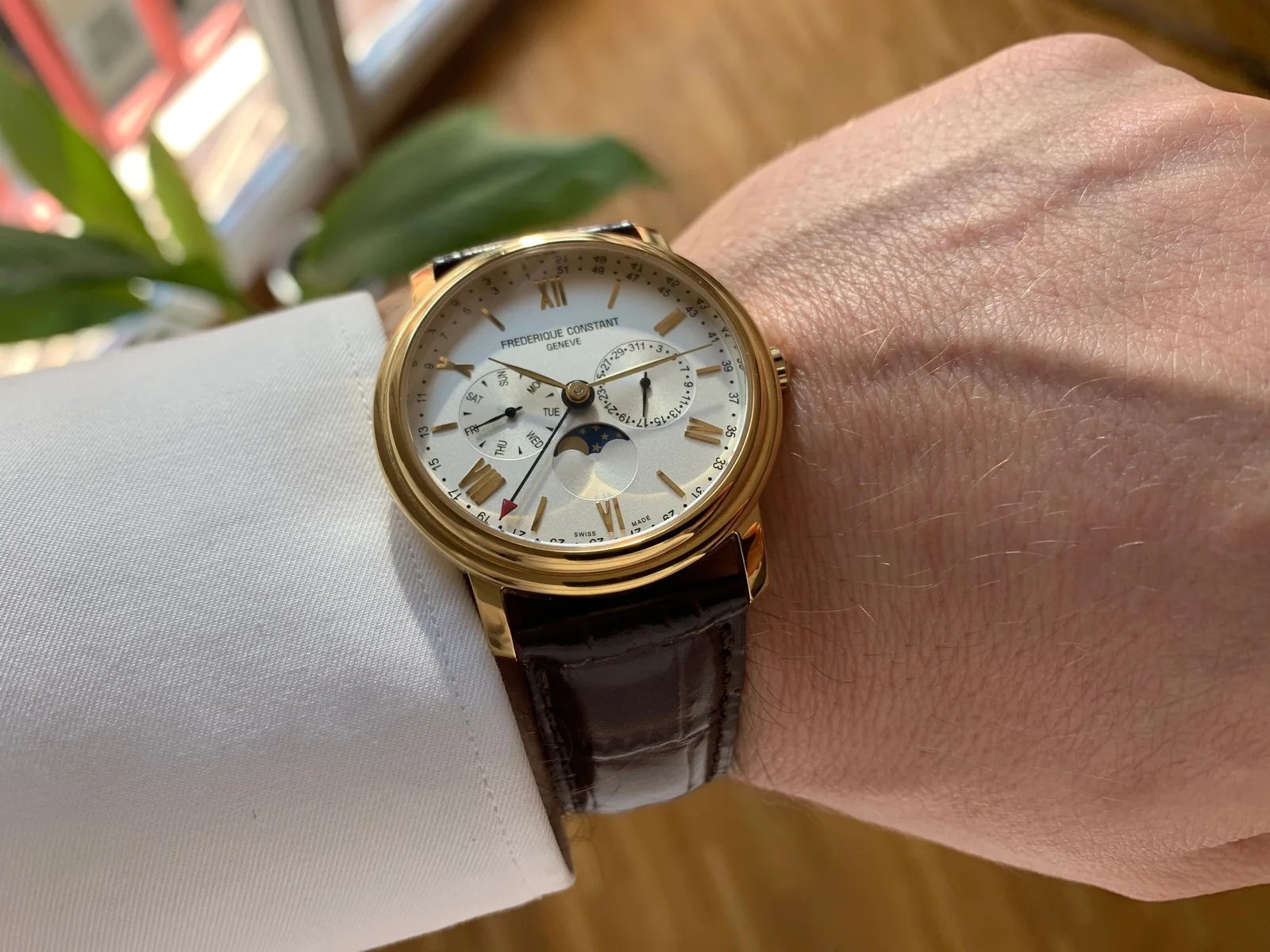
It follows many of the same principles I use when photographing jewellery and precious pieces. Light should not simply illuminate, it should draw. On a watch, it needs to reveal the curve of the crystal, the finesse of the indices, the texture of a sunburst dial, the depth of a blue tone or the warmth of gold, without turning the whole piece into an uncontrollable mirror.
Watch photography constantly reminds me that beautiful light is thoughtful light. It is not chasing effect for effect's sake. It is looking for readability, accuracy and elegance.
Material: metal, glass, leather, lacquer, textile
One of the things I love most about watch photography is the dialogue between materials. A watch is never a single, uniform surface. It is a meeting point between different visual worlds.
Metal can be polished, brushed, satin-finished or textured. Glass can reflect the environment or almost disappear if the light is placed correctly. Leather brings a warmer, more tactile feeling. Rubber and textile tell a different story, often one of sport, movement or modernity.
For an image to feel convincing, each material has to be respected. I do not light steel the way I would light rose gold. I do not treat a glossy black dial the same way I approach a pale textured one. I do not work with a metal bracelet as I would with leather.
Material is a language. When you understand it, the image becomes much more believable.
Detail: not an obsession, but the subject itself
In many areas of photography, detail is a complement. In watchmaking, detail is often the main subject.
A lug edge, guilloché texture, the contrast between polished and brushed surfaces, a blued hand, a crown, typography, index alignment, the depth of a sub-dial: these are the micro-elements that separate a merely pretty image from one that is genuinely useful.
Useful for a brand, because it highlights the real work behind the object. Useful for media, because it documents. Useful for collectors and enthusiasts, because it helps them see. Useful for communication, because it creates a sense of seriousness and coherence.
This discipline always reminds me that photography is not only an aesthetic language. It is also a language of precision.
What watchmaking teaches me about composition
When the subject is small, composition becomes even more important. A watch can quickly feel heavy, flat or generic if the framing is not right. I need to find the right distance, the right angle and the right relationship between the object and the space around it.
I like to alternate different kinds of images:
- clear hero shots that present the piece
- tighter sensory close-ups that reveal texture and finishing
- measured lifestyle images when they genuinely support the brand story
- craftsmanship details and gestures when they tell the story better than the product alone
In an editorial or corporate setting, this variety is valuable. A watch brand does not need one beautiful image. It needs a coherent visual language that can support a website, a press release, a press kit, a trade event, social content, and sometimes even an annual report.
That is also why my corporate work goes beyond portraits. A well-built image library can connect people, brand universe, product and place. It is the same logic I apply when creating corporate photography in Geneva or visuals for annual reports.
Showing luxury without falling into cliché
In the luxury world, the real trap is often cliché. Too much visible perfection can make an image feel cold. Too much effect can weaken the product. Too much staging can distract attention.
I prefer a more sensitive approach. When luxury is photographed well, it does not need to be overplayed. It can be felt in the quality of materials, the coherence of the frame, the restraint of the light, the precision of the retouching, and the overall trust the image inspires.
That feels particularly true today, at a time when overly polished, overly perfect or overly artificial images can create distance. Even in a high-end universe, what still resonates most is what feels real, controlled and sincere.
At Geneva Watch Days, the image also tells an atmosphere
What I love about an event like Geneva Watch Days is that it is not only about the watches themselves. It is also about the atmosphere: encounters, gestures, conversations, the way pieces are presented, tried on and observed. There is a very specific tension between technique, transmission, commerce, passion and emotion.
Photographing this world means moving between two complementary approaches:
- product precision
- editorial and event storytelling
One shows the object. The other shows what the object creates.
And it is often in that movement between both that images become truly strong. A brand does not only want people to see its watch. It also wants them to feel something when looking at it.
Why this matters for Geneva-based brands
In Geneva, watchmaking is not an abstract backdrop. It is an ecosystem, a culture, an economy and an identity. For brands, workshops, creators, distributors and partners, imagery plays a decisive role. It shapes the perception of quality, the level of desire, the understanding of craftsmanship and the coherence of the brand.
That is why strong watch photography serves several purposes at once:
- presenting a new launch or collection
- feeding press and digital communication
- supporting a launch event or trade-show presence
- enriching a website or premium e-commerce experience
- documenting crafts and gestures
- anchoring a brand inside a credible visual universe
This is why I see photography not as the production of pretty images, but as a positioning tool.
What I take away from it
Photographing a watch keeps teaching me the same lesson: look more slowly. Observe before acting. Understand the material before lighting it. Understand the object before staging it. Understand what a brand wants people to feel before trying to create a seductive image.
At Geneva Watch Days 2026, that lesson feels even more obvious. In a world saturated with images, the difference does not necessarily come from spectacle. It often comes from precision, restraint and attention to the details that truly matter.
If you need imagery for a maison, a brand, a workshop, an event or a launch in the Geneva watchmaking world, I would be delighted to discuss it. I love projects where light, material and craftsmanship deserve to be looked at closely.
Sources
- Geneva Watch Days, practical information and dates: https://gva-watch-days.com/
- Switzerland Tourism, Geneva Watch Days 2026: https://www.myswitzerland.com/en-ch/experiences/events/geneva-watch-days/
- Fondation de la Haute Horlogerie, FHH x Geneva Watch Days 2026: https://www.hautehorlogerie.org/en/events/fhh-x-geneva-watch-days-2026